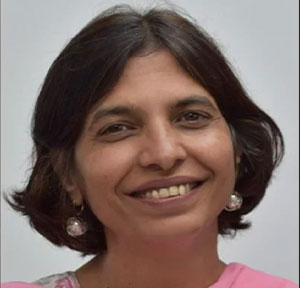
Indira Didi, an Anganwadi worker in Rajasthan is braving all the difficulties posed by the coronavirus pandemic and continue working to spread awareness about COVID-19 and distribute dry ration in her village
A usual day at Tarpal village located around 53 km from Udaipur, always buzzing with activities – with noisy children scurrying around, Anganwadi didis going about their job with a sense of responsibility, by passing on the message of overall health for mother and child, door-to-door. Maintain a healthy lifestyle, motivatE expecting mothers to take care of themselves, survey the children of the house to see if they are healthy and not malnourished. But unexpected coronavirus crisis struck and put a permanent halt to these activities in the village since March.
Indira Garg, a proud Anganwadi didi who decided to brave all odds amid coronavirus pandemic and continue to work towards making her village swasth. She says, I love my job, as it allows me to serve my community people. Today, I am proudly called an anganwadi didi, this job has given me a certain status in the community – both financially and mentally. Joining this service has made me more independent and have empowered me.
Indira Didi has been trained for such counselling under RajPusht programme, which has been implemented by IPE Global, an international development consultancy group providing expert technical assistance in developing countries, with support from Children’s Investment Fund Foundation (CIFF) in Rajasthan. RajPusht combines two interventions to reduce low birth weight and wasting in the state.
RajPusht engages the 3As: ASHA, Anganwadi and Auxiliary nurse midwife (ANM) for its implementation and strengthens their capacities to deliver health and nutrition programmes in the state.
A day in a life of Indira Garg in the normal times looked like this – every morning she used to get up at the first light of the dawn, complete her household chores and then finally head to the village Anganwadi centre, which she only would open up at every day.
She adds,
It is a satisfying ritual, I look forward to everyday.
Being an anganwadi didi, Indira Garg has certain duties to do in the village. Explaining her work, Indira Gard added,
We must do door-to-door surveys, keep an eye out for migrants, and educate people about necessary precautions in terms of health. We are also expected to support services like weight monitoring, take home ration (THR) distribution, contraceptive distribution to name a few things.
COVID Pandemic And How It Changed Life Of Indira Didi
But with the arrival of COVID pandemic, Indira Garg’s life changed as due to the nationwide lockdown, all the anganwadi centres had to be closed. This left a void in Indira didi’s daily life, she was also left worrying for the little children who used to come to the centre every day for food and learning, for the pregnant and lactating women who came every week to get their Take Home Ration (THR), their ANC (Antenatal care) check-ups, and for the mothers of the newly born children for whom the monthly check-ups at her centre are very critical. As the deadly virus spread, situation in the village got worse. Five persons of a family WERE detected positive near the centre itself and one person was reported dead due to the virus. All of this made it increasingly difficult for Indira to leave home and her family and engage with the community to deliver the services of the centre.
At the same time, while Indira was grappling with all fluid situation of the COVID outbreak, her husband lost his job. He used to work in a small restaurant near the city, lockdown forced the owner to shut down the shop.
It was a very difficult time for me and my family. We have two little children and had no extended family to support. I couldn’t sleep well, there was a constant fear of how will we sustain our family and the fear of each and every villager for whom Anganwadi services are very crucial.
Few days later, anganwadi workers were asked to join the war against COVID-19 and reach out to the remotest of their villages to tackle the pandemic. Though Indira Didi was happy to join back work, her family got scared and opposed the idea of her leaving the children and going out in the open when the virus was spreading faster than before. Indira’s husband asked her to leave the job.
Leaving job was not a solution. I was just not willing to leave. After many days of constant discussion and assurance of following all precautionary measures my husband agreed to let me go out for distribution of home rations. This was even more necessary now, because of the pandemic, services have been disturbed and people of the village were not getting access to good nutritious food.
However, the community members were not ready to let her visit them. They all feared the virus and thought letting Indira in will mean they are letting the virus come to their house. People were apprehensive and didn’t cooperate at all, especially for taking weight and measurement of their children.
She added,
It is frustrating to see people not having trust in us. We were once called as anganwadi didis, children and people loved coming to her, they used to let us take care of them. But now it is all very different. It was frustrating, but I didn’t let the negativity hamper my spirit. I decided to keep fighting the situation and keep convincing people to let me come to their house. I had to gain back their trust. I knew I cannot let these things fail me.
Indira along with another ASHA workers of the village, went all out to create awareness about the coronavirus and the safety measures villagers need to take to stay safe from the virus. The duo started counselling people. They tried to talk to people on various issues related to health, nutrition, and COVID-19.
Though initial reaction was not welcoming but gradually situation started to turn in our favour. When community members saw anganwadi didis’ dedication and the way they are going all out to make the people aware and supporting the community amid the pandemic, they have started to trust us again. They are once again have started to welcome us in their home.
Coronavirus Precautions: How The Anganwadi Didis Are Fighting The Battle
I wear mask every time I head out of my home. I know the importance of keeping ourself and our community safe in this pandemic. Not just mask, I have a sanitiser with me at all times and I try and maintain a good hand hygiene. Moreover, since the work requires lot of noting down, I try and use a new pen every day. After a hard day’s work when I return home, I first take a bath and only then touch and hug my children. It is not just the angandwadi workers who wear A mask now, because we have guided the people of the village about the pandemic, we see everyone wearing one now. I am happy that anganwadi workers have regained the villagers trust and I am thankful to my family who allowed me to do what I love the most.
Today, Indira is known as the fearless lady of her village, who is braving all odds amid a pandemic to fight for the health of everyone in the village. Being an Anganwadi worker is a matter of pride and source of empowerment for Indira and there are many such fearless women out there who are serving their community people amid the crisis. COVID has put forth many challenges in their lives and yet they have not only ensured the services of AWC go on without any interruption, but have also provide government with much needed support in creating awareness about COVID, its safety measures, tracking and monitoring of COVID patients in remotest villageS across the country.
Talking about COVID and how it has impacted the nutrition in India at a time when the work of anganwadi didis is the only hope to meet the nutritional goals India has set for itself, Raghwesh Ranjan, Director, Social and Economic Empowerment, IPE Global, said,
There are some of the early signs that we are seeing due to COVID-19 pandemic. There might be a delay in meeting nutritional targets that India has set for itself such as under government’s flagship initiative Poshan Abhiyan, the aim is to reduce stunting, underweight, and low birth weight, by 2 per cent every year; and anaemia among young children, adolescents and women each by 3 per cent per year until 2022. A special target for stunting is set at 25 per cent by the year 2022, according to Ministry of Women and Child Development under which Poshan Abhiyan was introduced.
He further said that due to COVID-19 pandemic anganwadi services have been disturbed and added,
As far as anganwadi centres are concerned, despite these centres being functional, there is a fear among women due to COVID that has curtailed their participation in Antenatal care (ANCs). If the pandemic continues for long, more numbers of women will not attend ANCs, thus risking their own health and the health of the child. Secondly, since the schools are shut across the country, there are chances that many girls will not come back to schools, which also means that they will be married off early and therefore get into the whole process of frequent and early pregnancies and that will also affect their ability to deliver healthy babies. Under the national nutrition mission, reduction of low-weight babies is an important target.
Sharing examples of Rajasthan and how the state is tackling the issue of nutrition and why more states should follow suit, especially during these unprecedented times, Mr Ranjan added,
COVID will impact nutrition or health of India, but the problem is that no-one knows how much it will impact as currently no one has the answer till when the pandemic will go on. At such a juncture, what becomes important is every authority, every state should come together to fight it together and in all this the role of anganwadis is very important. What Rajasthan has done is something I would like the other states to follow – the state is giving a mix of take home dry-ration (THR), which is basically a high-protein combination to its pregnant women and their families. The packet has 1kg of dal, 500 grams of ground nut, half a litre of oil and 100 grams of sesame seeds. The combination is what I would suggest other states should focus on – it should be a mix of all important nutrients instead of something which will be only good for making a halwa or khichadi. Secondly, I think is the channel in which the anganwadi workers are ensuring that take home ration is going to all the beneficiaries. They are making sure it reaches the women who are in the dire need currently as services are disturbed due to coronavirus lockdown. It is very important that on ground there is some kind of programmes running to ensure smooth working and distribution of government implemented programmes or services.