Crafting Futures in Bagru: Vocational Education and New Dreams

Devlina Bhattacharjee

Devlina Bhattacharjee

Devlina Bhattacharjee is an Analyst with the Partnership and Strategic Initiatives team at IPE Global. She holds a Master’s in Education from TISS, Mumbai. An educator at heart, she enjoys writing and reflecting on the world through unique observations.

Bagru, Rajasthan

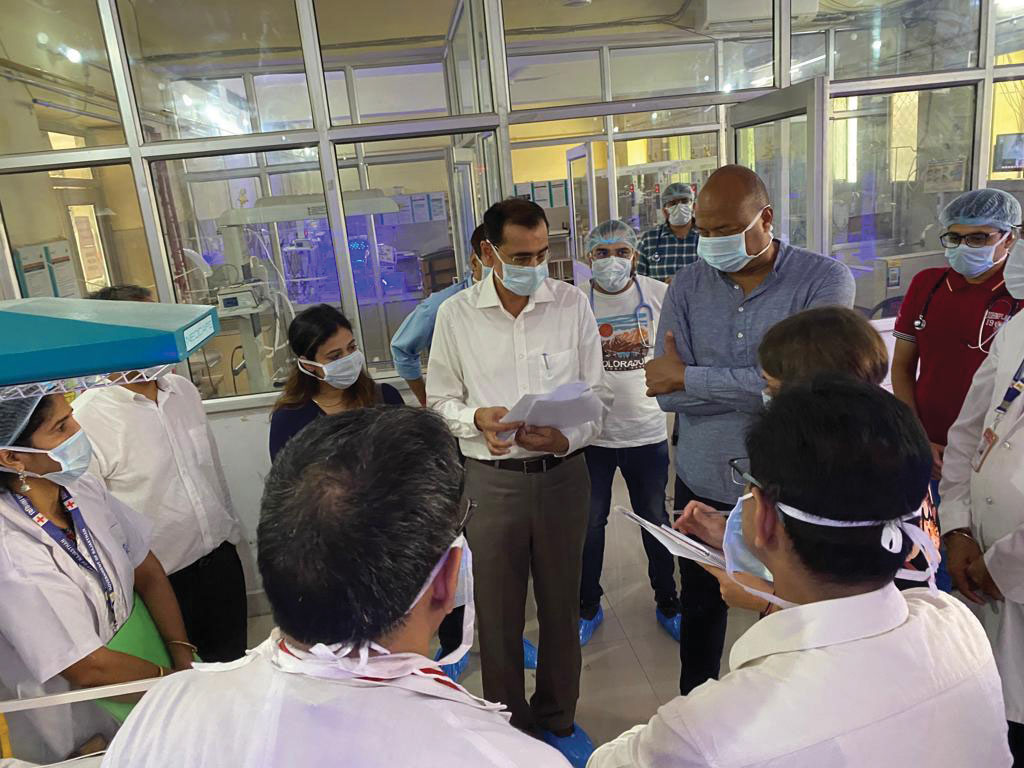
Bagru, a small town just an hour’s drive from Jaipur, is best known for its centuries-old tradition of hand-block printing—specifically Bagru and Dabu prints. We entered a bustling morning market before arriving at the Government Girls Senior Secondary School, tucked away behind leafy gates. A vibrant Hindi-medium campus of over 800 girls, it radiated the kind of energy you hope to find in a place meant for learning and growing.

‘We’, being Srijita and me, are visiting this girls’ school in Bagru to see and understand firsthand how vocational education under Manzil impacts these young lives. The visit started by meeting the principal in his office, and the vice-principal joined soon after. The school’s principal has been deeply invested in the vocational education programme operational in the school since 2019 and has made it a personal mission to see the success of the programme. The school offers two VE streams: Beauty & Wellness (B&W) and IT/ITES, which run from grades 9 to 12, with daily periods.

We visited both the B&W and the IT/ITES labs.

The B&W lab was vibrant and fully equipped – salon chairs, hair wash units, mani-pedi stations, and projects made by the girls. The IT lab was equally well-equipped — rows of desktops, colourful posters, and project work that reflected both digital literacy and job readiness.

On the day of our visit, the corridors buzzed with anticipation for the visit and interactions that were to follow. “What do you find in Bagru that you don’t find in your Delhi?” one girl asked us playfully. The answer – “the people, the town melas, and YOU all” – led to giggles, but beneath the banter was a deeper sense of pride in their place and identity.

The New Narratives Emerging from Vocational Education

While traditional norms still push girls toward marriage and domesticity, the vocational education labs tell a different story. Talking to the girls, it became clear to us that Manzil hadn’t just plugged in some skill gaps; it had cracked something open. It had handed them a mirror and said, “Look – this is who you could be.” While some stories followed the expected path (course → skill → job), many revealed interesting and surprising ways in which vocational education was shaping their choices and aspirations.

In the B&W class, girls discussed their aspirations with clarity and ambition. Nandini, who always wanted to be a makeup artist, joined the course with a purpose. Payal dreams of opening her own salon in the city of Jaipur. Sejal, a science student, always wanted to be a doctor. After learning about skincare and anatomy through the B&W course, she now aims to become a “skin doctor”, a dermatologist, merging vocational knowledge with her career aspirations. Others, like Priyanka, who come from a single-parent household with six siblings, see the course as a means to ease their family’s financial burden by starting to earn.

Similarly, girls in the IT/ITES course know too well that “the future is in technology and computers”. Beyond learning digital tools, the girls were exposed to polytechnic colleges, ITIs, and e-mitras (government-run digital service centres that offer access to public services and job-related resources). Bhavna, from the IT course, shared her plans to start a “low-investment, high-profit” business, which, according to her, is a fast-food stall in a busy area, using her digital and employability skills. Ayushi was already using her training at home – paying bills, booking tickets, and supporting her father’s business using her computer skills to digitise some of the tasks he currently does manually. Their vocational trainer put it rightly, “they were trained e-mitra service providers in their homes and neighborhoods”.

The girls spoke of going to work and earning, opening and scaling their own businesses, supporting their families, becoming doctors, teachers, chartered accountants, IAS officers and what not! But now, they aren’t just imagining futures – they’re planning them, actively and decisively.

Nusrat’s Story: A Portrait of Courage

Among the many stories that moved us, Nusrat’s stood out.

Nusrat joined the school in grade 9, switching from an English-medium school to Hindi-medium. Though the shift was tough, she adapted quickly – with the help of her teachers – and emerged as one of the school’s toppers.

But Nusrat’s real education happened outside the classroom. She apprenticed at a beauty parlour, learned IT skills, taught tuition classes, and secretly saved money – all without her family’s knowledge. Her father disapproved of her working, so she quietly built her skill set and future, determined to one day start her own salon.

In the B&W course, Nusrat became a peer trainer, assisting classmates in both theory and practice. Even after graduation, she returns to guide younger students – carrying her own equipment and mentoring them voluntarily.

Despite securing a scholarship for a B.Sc. degree, family pressure and a forced marriage proposal derailed her college plans. When confronted by her father, she revealed that she had saved ₹1.5 lakh from her freelance work and part-time job. “If you force me,” she told him, “I will run away – not with a boy, but for my career.”

Today, Nusrat continues working towards her dream – running her own salon, where she hopes to offer free training and employment to local girls and widows. Her younger sister is now enrolled in the same vocational course. Nusrat’s vision is not just personal – it’s communal – she plans on creating more and more jobs for girls like her – “They deserve to dream, too,” she says.

Final thoughts: What future are you nurturing when you enable someone’s potential?

I walked into a school that day. I left with a different understanding of freedom. It doesn’t always arrive with fanfare – sometimes, it shows up as a desktop computer, a salon chair, a class on employability skills. Sometimes, freedom is braided quietly into a girl’s hair with her own hands. That’s what vocational education is doing here – not just plugging skill gaps but unlocking agency, shifting aspirations, and offering girls a path they didn’t know they were allowed to take. Before Manzil, many of them didn’t realise they could dream beyond what was set for them – and even if they did, they didn’t know how to begin. Manzil brought the “how” into their classrooms. It placed the tools, trainers, and confidence within reach. Like block printing, where each bold pattern begins with a single carved block, this is where new futures are being printed — one skill, one class, one choice at a time.
FROM THE DESK

Latest Blogs

Anand Roop

Anandroop Bahadur

Group Head – Human Resources

Expertise

Human Resource Expertise, HR Strategy, Oragnisational Design, Talent & Leadership Development, Policy Governance

Anandroop Bahadur is a seasoned HR leader and strategic advisor with nearly two decades of experience across the development, consulting, and social impact ecosystem. She brings a strong blend of deep technical HR expertise, organizational design acumen, and a people-centric ethos to her work.

At IPE Global, Anandroop leads the Group Human Resources function across IPE Global and its associated entities, including Triple Line Consulting and IPE Africa. Her focus is on strengthening organizational foundations, enabling leadership effectiveness, and building scalable people systems aligned with the organisation’s global growth ambitions. Her remit spans HR strategy, organizational design, talent and leadership development, compensation and performance frameworks, policy governance, safeguarding, and culture integration across geographies.

Over the course of her career, Anandroop has held senior HR leadership and consulting roles with organisations such as Clinton Health Access Initiative (CHAI), Ford Foundation, NASSCOM Foundation, Central Square Foundation, Amity Education Group, and other international institutions. She has advised leadership teams and boards through periods of scale, transition, and transformation, and has led HR operations in high-growth, high-complexity environments.

She holds an Executive Degree in Human Resources from XLRI Jamshedpur and is a SHRM–SCP (Senior Certified Professional), reflecting her grounding in global HR standards and best practices. She has also completed advanced executive and leadership programmes, including training in coaching and organisational transformation, and is an ICF-trained executive coach, currently working towards her ACC credential.


Nikos Papachristodoulou

Nikos Papachristodoulou

Director

Expertise

Urban, Infrastructure, Disaster and Climate Resilience, Inclusive Growth

Nikos has expertise in urban and regional economic development, infrastructure, disaster and climate resilience, and inclusive growth. He oversees and manages projects for Triple Line’s cities and infrastructure portfolio.

Nikos is an urban specialist, with principal areas of expertise in urban and regional economic development, infrastructure, disaster and climate resilience, and inclusive growth. Over the past 12 years he has worked for a range of clients including the World Bank, FCDO, EU, USAID, Cities Alliance, Global Green Growth Institute (GGGI), Norwegian Refugee Council (NRC), and local authorities.

Nikos’s work has incorporated the full spectrum of the project cycle, from analytics and programme scoping and design, through implementation, and evaluation and learning.

He has a high level of familiarity with HMG business cases and ODA eligibility criteria having led and supported the development of FCDO’s urbanisation strategy and options for future investments in Somalia’s cities, Prosperity Fund Global Future Cities Programme (GFCP) scoping in Nigeria, and the development of the business case for an urban resilience programme in Tanzania.

Nikos also brings excellent understanding of World Bank latest trends and procedures as a result of his involvement in a number of analytics and technical assistance projects, including on informal settlements upgrading in Mogadishu, climate change adaptation planning in Latin American and Caribbean cities, assessment of the climate resilience of Dar es Salaam’s transport infrastructure, spatial development in Nigeria, and preparation of a handbook on integrated urban flood risk management.

Nikos holds a BSc in Economics from the University of Piraeus and an MSc in Social Development Practice from the Development Planning Unit at University College London (UCL).


Ricardo Pinto

Ricardo Pinto

Associate Director

Expertise

Private Sector Development, Regulatory Reform, Regional and Local Economy

Ricardo has 35 years´ experience in private sector development, regulatory reform, regional and local economic development in the European Union, Western Balkans, Easter Partnership Countries, Middle East, Africa, etc. He is tasked with developing our strategic operations in continental Europe and Ukraine.

Ricardo is a seasoned international development professional with over 30 years of experience designing and delivering Private Sector Development and economic growth initiatives across more than 50 countries spanning Central, Eastern and Southeast Europe, the CIS, Africa, MEDA, and Asia. He holds both a bachelor’s degree and PhD from the London School of Economics and Political Science (LSE) and is a Certified Management Consultant (CMC).

Ricardo brings a unique combination of strategic insight and practical implementation expertise. He has led high-impact assignments for key development institutions, including the European Commission, OECD, GIZ, FCDO/DFID, UNDP, UNCTAD, EBRD, ILO, ADB, World Bank, USAID, and Danida.

With a deep and practical understanding of institutional architecture, policy environment, and post-conflict recovery dynamics, and a career spanning over 30 years across transition economies, Ricardo brings not only technical depth but also a trusted reputation among donors, policymakers and peers.He is leading Triple Line’s strategic expansion into continental Europe, including Ukraine, while strengthening our credibility across the broader region and beyond. Proven Expertise Across Our Core Pillars. Ricardo’s work focuses on the areas central to Triple Line’s evolving service offering: Governance & Institutional Reform: advising public institutions on regulatory impact, policy reform, and donor coordination, Private Sector Development: strategy development for SME ecosystems, innovation, and competitiveness, Infrastructure Enabling Conditions: support for investment climate improvement and regional/local economic development and Cross-cutting themes, including green transition, women’s economic empowerment, and inclusive growth

 
LIFE AT IPE

Learning &
Development (L&D)

We inspire people to be better.

Our intuitive and personalised programmes provide clear path for growth, leadership development, and help people sharpen their skills.

0 %
People trained in last 3 years
0 %
Participation in L&D Initiatives in 2025

Your journey starts from Day One….

Structured Onboarding

Helps align expectations and lays the foundation for your success

New Hire Training

Makes you familiar with the organisation; helps you settle down in a new work environment

Customized L&D Platform

Helps upskill at your own pace through continuous learning and training programmes

Linkage with
Performance Management

Aligns resources and training needs based on your skill set

Learning is not always a formal process. We also align our organisation values to a culture of learning