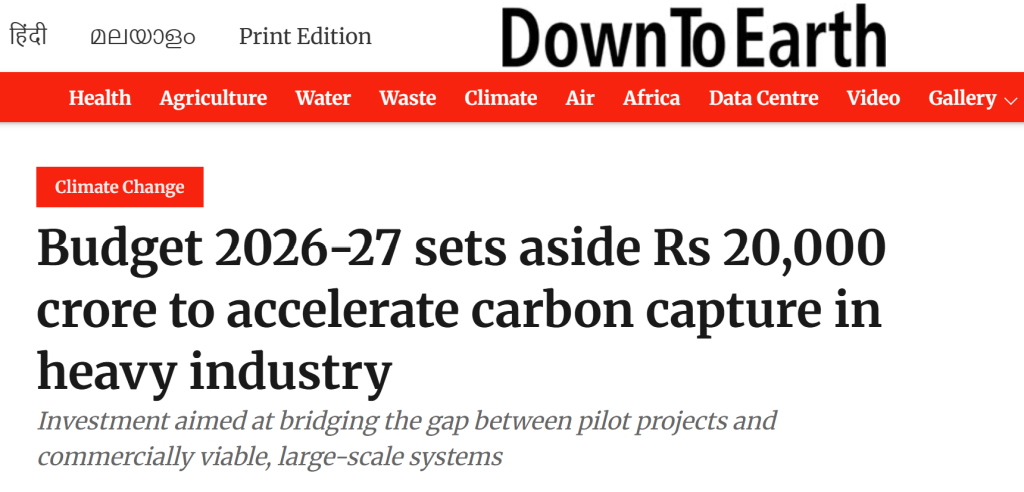
Budget 2026-27 Sets aside Rs 20,000 Cr to Accelerate Carbon Capture


In a significant policy signal on industrial decarbonisation, Union Finance Minister Nirmala Sitharaman proposed an outlay of Rs 20,000 crore over the next five years to scale up carbon capture, utilisation and storage (CCUS) technologies, positioning them as a key pillar of India’s long-term climate and industrial strategy. 

The announcement, made in Parliament during the Union Budget 2026–27 speech on February 1, 2026, aligns with the national CCUS roadmap released in December 2025 and targets large-scale deployment across power, steel, cement, refineries and chemicals, sectors widely considered among the hardest to decarbonise.

Sitharaman said the investment is intended to help CCUS technologies reach higher levels of technological and commercial readiness in end-use applications. These sectors account for a substantial share of India’s industrial emissions, and in many cases lack cost-effective alternatives to deep emission cuts. The funding is, therefore, aimed at bridging the gap between pilot projects and commercially viable, large-scale systems.

Part of Net Zero 2070 strategy

The CCUS push is embedded in India’s broader commitment to achieve Net Zero emissions by 2070. The Research, Development and Innovation Roadmap for CCUS, released by the Department of Science and Technology in December 2025, outlines a long-term ambition to capture 750 million tonnes of carbon dioxide (CO2) from hard-to-abate sectors such as steel and cement by 2050. This roadmap focuses on advancing indigenous technologies, promoting demonstration projects, enabling international collaboration and attracting private investment.

DST defines CCUS as a set of technologies designed to prevent carbon dioxide from entering the atmosphere by capturing emissions from industrial processes or power generation, and then either storing the CO2 permanently in geological formations or utilising it in products such as chemicals, fuels or building materials. In operational terms, this may involve separating CO2 before combustion (pre-combustion capture), after combustion (post-combustion capture), or from industrial process streams, followed by compression, transport — often via pipelines — and storage in deep underground formations such as depleted oil and gas fields or saline aquifers.

Global context & debate

Internationally, CCUS is increasingly seen as an important, though not uncontroversial, tool in climate mitigation portfolios. According to the Global Carbon Capture and Storage Institute, there are about 50 operational CCUS facilities worldwide, collectively capturing around 50 million tonnes of CO2 per year. Around 44 projects are under construction and more than 500 are in various planning stages, reflecting growing interest, particularly in North America and Europe.

However, the technology’s role remains debated. A 2025 report by the World Resources Institute highlighted two persistent concerns: The slow pace of deployment relative to climate targets and the risk that CCUS could entrench continued fossil fuel use by providing a technical fix that delays structural shifts toward cleaner energy systems. Critics also point to high costs, energy penalties and unresolved questions around long-term storage liability.

Industry perspective: From policy to projects

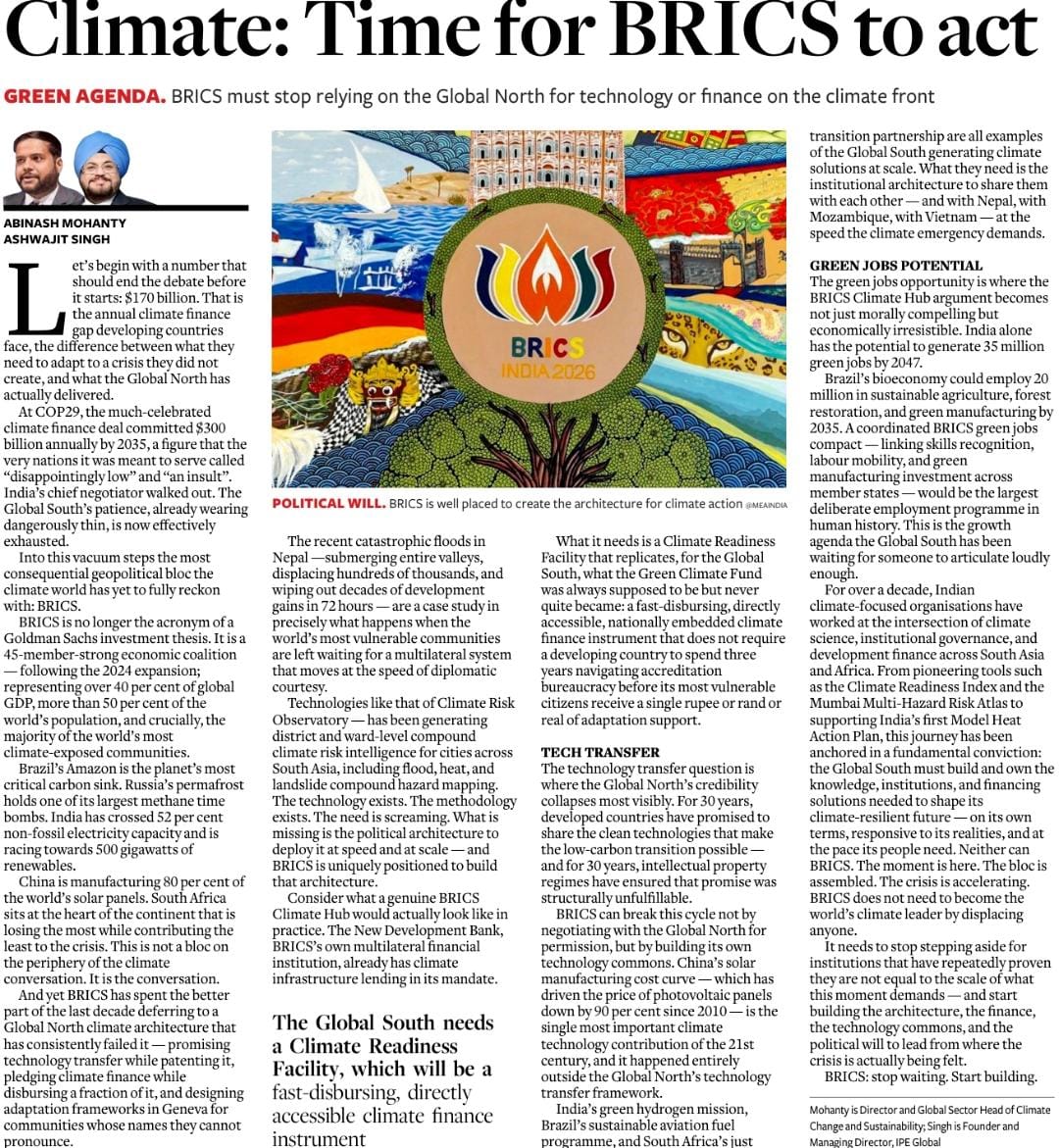
Indian industry and climate experts have largely welcomed the Budget allocation as a pragmatic move. Abinash Mohanty, Global Sector Head for Climate Change and Sustainability at IPE Global, said the commitment signals recognition that CCUS is indispensable for emission reductions in sectors where electrification or fuel switching is not yet viable.

Atanu Mukherjee, President and CEO of Dastur Energy, stressed that the next challenge lies in execution. He noted that the funding must be channelled toward shared CO2 transport and storage infrastructure, early-mover risk support and commercial-scale demonstration projects. Clear regulatory frameworks covering measurement and verification of captured CO2, third-party access to transport networks and long-term storage liability will also be critical to attract private capital.

Balancing climate & competitiveness

For policymakers, CCUS offers a way to reconcile climate commitments with industrial growth. Steel, cement, refining and chemicals are central to India’s infrastructure and manufacturing expansion, as well as to employment and exports. Deep emission cuts in these sectors without transitional technologies could affect competitiveness and investment flows. By supporting CCUS, the government is signalling an approach that seeks to decarbonise without deindustrialising.

The Rs 20,000 crore allocation, therefore, is more than a research grant. It represents an attempt to anchor CCUS as a scalable industrial system integrated with India’s power, fuels and emerging hydrogen strategies. If successfully implemented, it could help India build domestic expertise in a technology expected to play a role in global decarbonisation, while addressing emissions from sectors where solutions remain limited.

The Union Budget 2026–27 marks a clear shift in treating resource security and decarbonisation as strategic economic priorities, said Masood Mallick, chairman of Confederation of Indian Industry national committee on waste to worth technologies and managing-director and group CEO of Re Sustainability. “It directly addresses the competitiveness challenge Indian industry faces under mechanisms such as the EU’s Carbon Border Adjustment Mechanism and provides a credible pathway for hard-to-abate sectors to remain globally competitive while decarbonising,” he said.
Anand Roop

Anandroop Bahadur

Group Head – Human Resources

Expertise

Human Resource Expertise, HR Strategy, Oragnisational Design, Talent & Leadership Development, Policy Governance

Anandroop Bahadur is a seasoned HR leader and strategic advisor with nearly two decades of experience across the development, consulting, and social impact ecosystem. She brings a strong blend of deep technical HR expertise, organizational design acumen, and a people-centric ethos to her work.

At IPE Global, Anandroop leads the Group Human Resources function across IPE Global and its associated entities, including Triple Line Consulting and IPE Africa. Her focus is on strengthening organizational foundations, enabling leadership effectiveness, and building scalable people systems aligned with the organisation’s global growth ambitions. Her remit spans HR strategy, organizational design, talent and leadership development, compensation and performance frameworks, policy governance, safeguarding, and culture integration across geographies.

Over the course of her career, Anandroop has held senior HR leadership and consulting roles with organisations such as Clinton Health Access Initiative (CHAI), Ford Foundation, NASSCOM Foundation, Central Square Foundation, Amity Education Group, and other international institutions. She has advised leadership teams and boards through periods of scale, transition, and transformation, and has led HR operations in high-growth, high-complexity environments.

She holds an Executive Degree in Human Resources from XLRI Jamshedpur and is a SHRM–SCP (Senior Certified Professional), reflecting her grounding in global HR standards and best practices. She has also completed advanced executive and leadership programmes, including training in coaching and organisational transformation, and is an ICF-trained executive coach, currently working towards her ACC credential.


Nikos Papachristodoulou

Nikos Papachristodoulou

Director

Expertise

Urban, Infrastructure, Disaster and Climate Resilience, Inclusive Growth

Nikos has expertise in urban and regional economic development, infrastructure, disaster and climate resilience, and inclusive growth. He oversees and manages projects for Triple Line’s cities and infrastructure portfolio.

Nikos is an urban specialist, with principal areas of expertise in urban and regional economic development, infrastructure, disaster and climate resilience, and inclusive growth. Over the past 12 years he has worked for a range of clients including the World Bank, FCDO, EU, USAID, Cities Alliance, Global Green Growth Institute (GGGI), Norwegian Refugee Council (NRC), and local authorities.

Nikos’s work has incorporated the full spectrum of the project cycle, from analytics and programme scoping and design, through implementation, and evaluation and learning.

He has a high level of familiarity with HMG business cases and ODA eligibility criteria having led and supported the development of FCDO’s urbanisation strategy and options for future investments in Somalia’s cities, Prosperity Fund Global Future Cities Programme (GFCP) scoping in Nigeria, and the development of the business case for an urban resilience programme in Tanzania.

Nikos also brings excellent understanding of World Bank latest trends and procedures as a result of his involvement in a number of analytics and technical assistance projects, including on informal settlements upgrading in Mogadishu, climate change adaptation planning in Latin American and Caribbean cities, assessment of the climate resilience of Dar es Salaam’s transport infrastructure, spatial development in Nigeria, and preparation of a handbook on integrated urban flood risk management.

Nikos holds a BSc in Economics from the University of Piraeus and an MSc in Social Development Practice from the Development Planning Unit at University College London (UCL).


Ricardo Pinto

Ricardo Pinto

Associate Director

Expertise

Private Sector Development, Regulatory Reform, Regional and Local Economy

Ricardo has 35 years´ experience in private sector development, regulatory reform, regional and local economic development in the European Union, Western Balkans, Easter Partnership Countries, Middle East, Africa, etc. He is tasked with developing our strategic operations in continental Europe and Ukraine.

Ricardo is a seasoned international development professional with over 30 years of experience designing and delivering Private Sector Development and economic growth initiatives across more than 50 countries spanning Central, Eastern and Southeast Europe, the CIS, Africa, MEDA, and Asia. He holds both a bachelor’s degree and PhD from the London School of Economics and Political Science (LSE) and is a Certified Management Consultant (CMC).

Ricardo brings a unique combination of strategic insight and practical implementation expertise. He has led high-impact assignments for key development institutions, including the European Commission, OECD, GIZ, FCDO/DFID, UNDP, UNCTAD, EBRD, ILO, ADB, World Bank, USAID, and Danida.

With a deep and practical understanding of institutional architecture, policy environment, and post-conflict recovery dynamics, and a career spanning over 30 years across transition economies, Ricardo brings not only technical depth but also a trusted reputation among donors, policymakers and peers.He is leading Triple Line’s strategic expansion into continental Europe, including Ukraine, while strengthening our credibility across the broader region and beyond. Proven Expertise Across Our Core Pillars. Ricardo’s work focuses on the areas central to Triple Line’s evolving service offering: Governance & Institutional Reform: advising public institutions on regulatory impact, policy reform, and donor coordination, Private Sector Development: strategy development for SME ecosystems, innovation, and competitiveness, Infrastructure Enabling Conditions: support for investment climate improvement and regional/local economic development and Cross-cutting themes, including green transition, women’s economic empowerment, and inclusive growth

 
LIFE AT IPE

Learning &
Development (L&D)

We inspire people to be better.

Our intuitive and personalised programmes provide clear path for growth, leadership development, and help people sharpen their skills.

0 %
People trained in last 3 years
0 %
Participation in L&D Initiatives in 2025

Your journey starts from Day One….

Structured Onboarding

Helps align expectations and lays the foundation for your success

New Hire Training

Makes you familiar with the organisation; helps you settle down in a new work environment

Customized L&D Platform

Helps upskill at your own pace through continuous learning and training programmes

Linkage with
Performance Management

Aligns resources and training needs based on your skill set

Learning is not always a formal process. We also align our organisation values to a culture of learning