Digitally Invisible: Have girls and women been left behind in Digital India?

The Digital India programme was launched in 2015 as the flagship programme of the Government of India to transform India into a digitally empowered society. However, it was the Covid-19 pandemic that truly gave it a push, with remote online-based work becoming the order of the day for offices, and even schools, which had to impart education online. Only during the pandemic did access to technology and the ‘digital divide’ in the country become an important discussion. 

According to the National Family Health Survey-5, 2020, there is a significant digital divide between men and women, and between rural and urban India, with rural women having the lowest access to the internet. While 73% of urban men have used the internet, the corresponding figure for women is 56%, and in rural India, it stands at 55% of men versus 34% of women. Combined with the statistics on female labour force participation rates — a figure where India has one of the world’s lowest — this makes for rather underwhelming statistics. For instance, female participation rates decreased to 20% in 2019 and further to 16% during the quarter of July-September 2020. Hence, unless the gender gap in technology — access to devices and the internet — is addressed, not only will India’s digitising ambitions remain unfulfilled, but it will also impact women’s participation in the labour market.

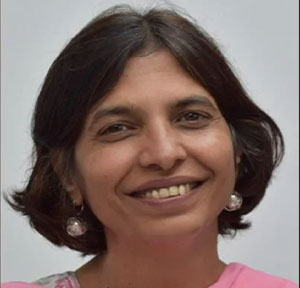
Ms Arti Ahuja

Arti Ahuja

Director

Retired from the Indian Administrative Services, Ms Ahuja has over 34 years of experience in administration, policy formulation, project management, and leadership across the public sector. Her expertise spans health systems, nutrition, women’s workforce participation, vulnerable populations, petrochemicals, and social sector programs. She has held several senior positions in the Government of India, including Secretary, Ministry of Labour and Employment, where she led reforms to strengthen worker welfare and represented India at the G20 Employment Working Group; Secretary, Ministry of Chemicals and Petrochemicals, where she initiated the Production Linked Incentive (PLI) scheme; and Secretary, Women & Child Development, where she directed large-scale nutrition and empowerment initiatives, strengthening the Integrated Child Development Services (ICDS). As Secretary of Health, Government of India she played a pivotal role in India’s COVID-19 response, launched the National Digital Health Mission, and advanced national programs on TB and AIDS control. She continues to advise on gender, climate change, and nutrition, contributes to national and international publications, and teaches public policy and nutrition at leading academic institutions. She holds a Master’s degree in Public Health from the Harvard School of Public Health; Master’s in Public Policy from Princeton University; Master’s in Economics (Gold Medallist) from Panjab University, and is a Bachelor of Law from the University of Delhi.

LIFE AT IPE

Learning &
Development (L&D)

We inspire people to be better.

Our intuitive and personalised programmes provide clear path for growth, leadership development, and help people sharpen their skills.

0 %
People trained in last 3 years
0 %
Participation in L&D Initiatives in 2025

Your journey starts from Day One….

Structured Onboarding

Helps align expectations and lays the foundation for your success

New Hire Training

Makes you familiar with the organisation; helps you settle down in a new work environment

Customized L&D Platform

Helps upskill at your own pace through continuous learning and training programmes

Linkage with
Performance Management

Aligns resources and training needs based on your skill set

Learning is not always a formal process. We also align our organisation values to a culture of learning