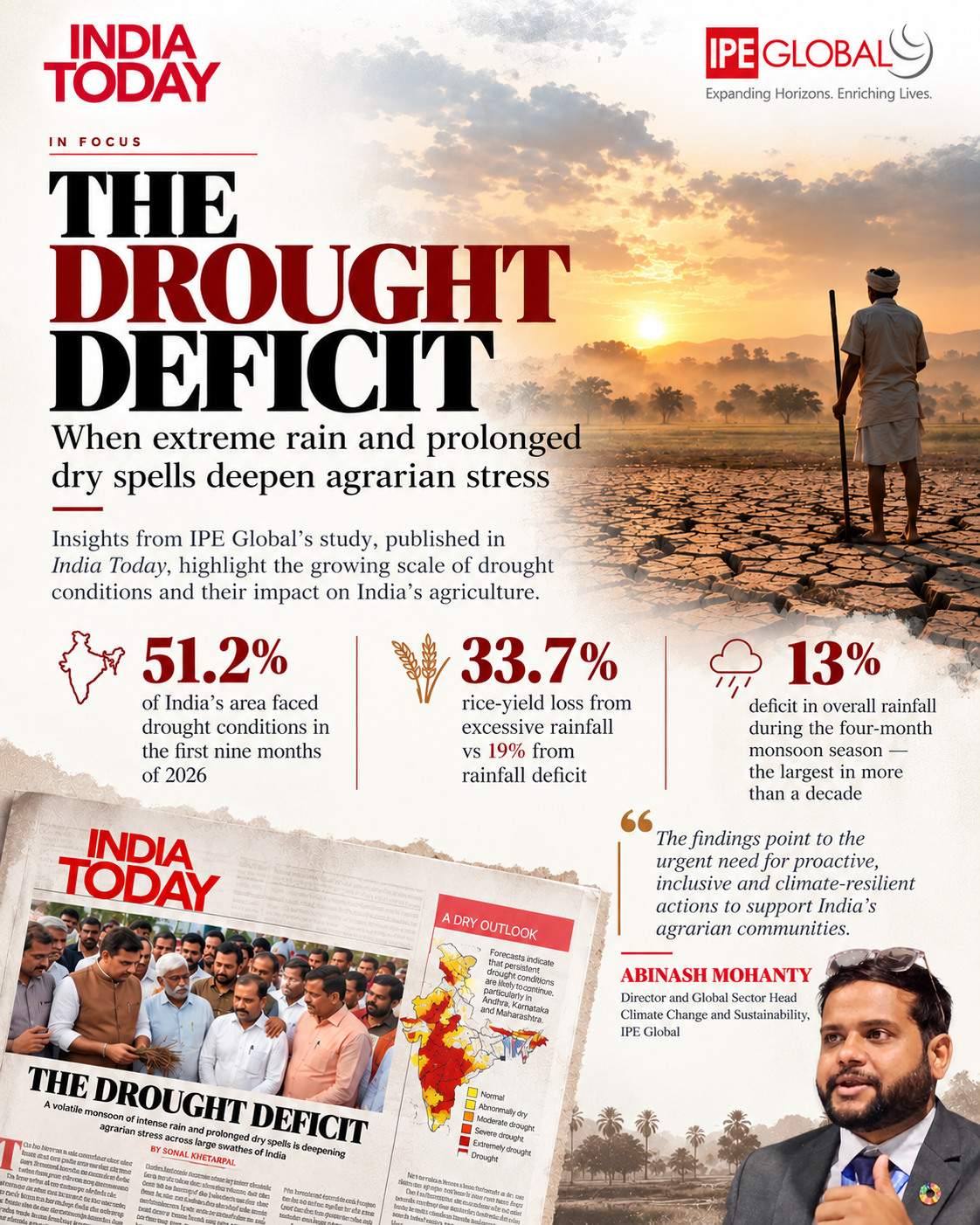
Abinash Mohanty, Director and Global Sector Head – Climate Change & Sustainability at IPE Global, is featured in India Today’s Upfront feature, “The Drought Deficit,” by Sonal Khetarpal, which examines how erratic monsoon patterns, El Niño and prolonged dry spells are deepening agricultural distress across India, highlighting the urgent need to shift from reactive drought relief to proactive climate preparedness.
Abinash highlights how drought risks are compounded by human-induced pressures, including excessive urbanisation, groundwater extraction and inadequate groundwater recharge. His perspective underscores a critical climate challenge: the issue is not simply how much rain India receives, but how rainfall is distributed, how water is managed and how effectively communities prepare for prolonged dry spells.
IPE Global’s research reinforces this growing concern. The State of Extreme Events study, developed with Esri India, found that:
- Over 85% of Indian districts are classified as extreme climate hotspots.
- Drought frequency has doubled, with southern, western, and central India increasingly exposed to agricultural and meteorological droughts.
- 45% of Indian districts are experiencing a shift between flood and drought conditions, highlighting the growing complexity of climate risks.
Further, IPE Global reports a 15-fold increase in extreme heatwave days over three decades, rising to a 19-fold increase in the last decade alone. It also projects that 8 out of 10 districts in India could experience multiple instances of incessant and erratic rainfall by 2030.
Together, these findings underscore the urgency of strengthening climate-risk assessment, early-warning systems, water-resource management and anticipatory planning. Translating climate intelligence into timely, actionable decisions for governments, farmers and communities will be essential to safeguarding livelihoods and building resilience against increasingly unpredictable weather extremes.