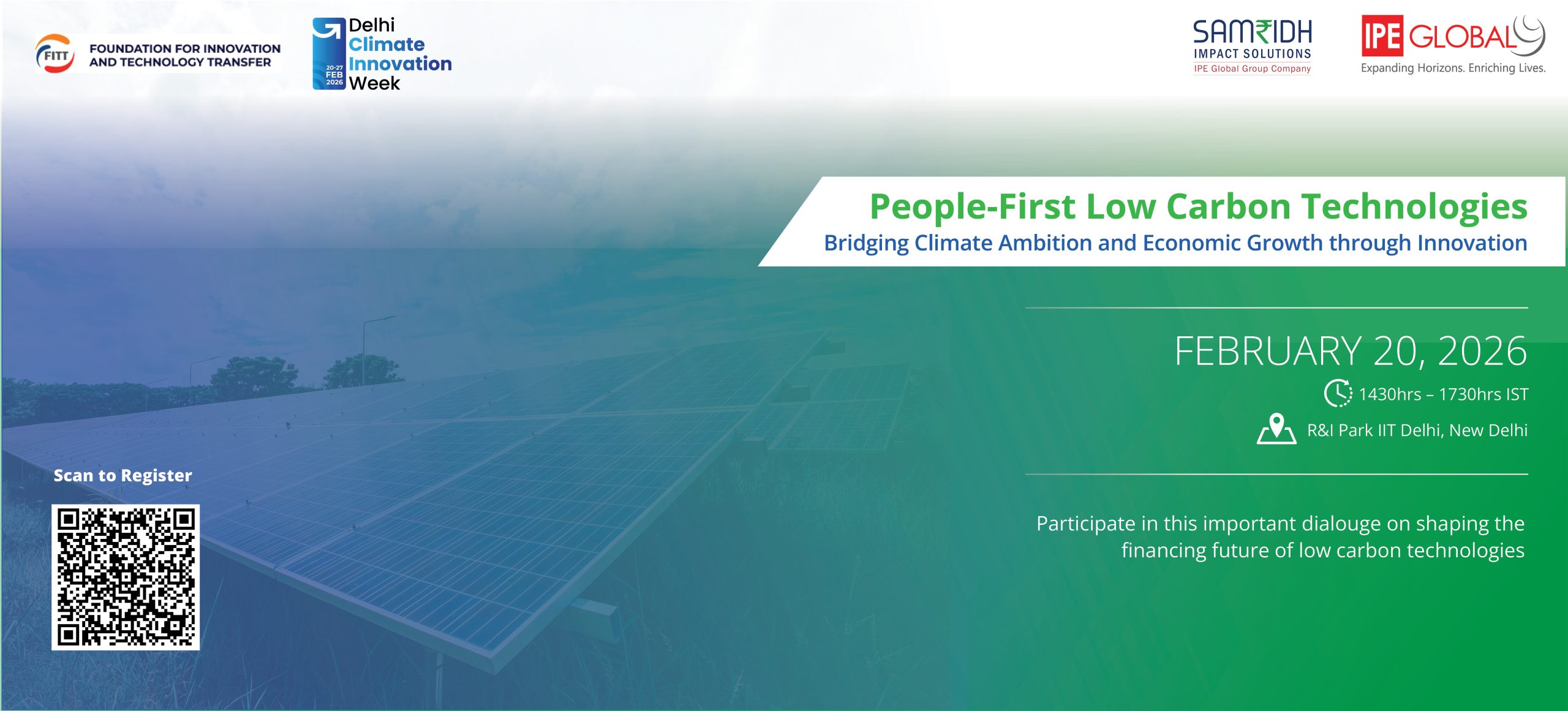
In the inaugural edition of Delhi Climate Innovation Week 2026, IPE Global and SAMRIDH Impact Solutions Pvt. Ltd. (SISPL) were proud to host a national dialogue titled “People-First Low Carbon Technologies: Bridging Climate Ambition and Economic Growth.” This session aligned with the People-Centric Climate Innovation and Just Transitions theme of Delhi Climate Innovation Week 2026, reflecting the growing recognition that climate solutions must deliver tangible social and economic benefits alongside emissions reduction. As India accelerates its climate ambition, the success of the low-carbon transition will depend not only on technological advancement but on how these technologies are designed, financed, and deployed to serve people, livelihoods, and communities.

Low-carbon technologies have become central to global efforts to align development with climate responsibility. They represent a systemic shift in how energy is produced, consumed, and managed, enabling economies to grow while reducing environmental impact. As climate risks intensify and regulatory, financial, and market pressures evolve, low-carbon solutions are no longer niche interventions. They are now core enablers of sustainable, resilient, and future-ready growth pathways. From a climate ambition perspective, low-carbon technologies are indispensable to achieving net-zero pathways and meeting global and national climate commitments. They directly contribute to reducing greenhouse gas emissions, lowering sectoral emissions intensity, and enabling a structured transition away from fossil fuels toward clean, energy-efficient, and sustainable alternatives. Technologies spanning renewable energy, energy efficiency, electric mobility, green hydrogen, sustainable cooling, and climate-smart industrial systems play a decisive role in decarbonising high-emitting sectors while strengthening long-term climate resilience. For India, the significance of low-carbon technologies extends well beyond emissions reduction. Their large-scale adoption has strategic economic implications, supporting the country’s aspiration of becoming a USD 5 trillion economy by strengthening domestic manufacturing, enhancing energy security, reducing import dependence, and unlocking new investment opportunities. However, achieving both climate and economic outcomes requires a deliberate shift towards people-first, low-carbon technologies. Affordability, accessibility, and contextual relevance must guide technology design and deployment, ensuring benefits accrue to workers, communities, consumers, and small enterprises.


CLIMATE ACTION

Integrating Climate Mitigation
& Adaptation

Mainstreaming Climate Mitigation and Adaptation Actions

Sustainable Food Systems

Sustainable Tourism

People- Centric Climate Risk Communication

Climate Finance

Climate Resilient Cities

CLIMATE ACTION

Mainstreaming Climate Mitigation and Adaptation Actions

The advent of technology has presented new options for energy transitions, even as climate change continues to gain attention as a global issue. Recent digital phenomena such as artificial intelligence (AI) and big data, can aid in the decarbonisation of economies by lowering emissions, creating sustainable infrastructure, and providing new options. Without addressing the needs of the community as a whole and compartmentalising climate mitigation and adaptation measures, the vision for successful and sustainable climate action cannot be accomplished.


Climate change is taking the largest toll on poor and vulnerable groups, and these impacts are largely caused by socioeconomic inequalities. Effective risk-transfer mechanisms will be needed to distribute rewards and liabilities among all stakeholders to achieve long-term climate action. We firmly believe that participatory, community-driven projects, focused on adaptation and mitigation, can reduce inequities and advance interconnected environmental goals.


Our cross-cutting interventions in remote and rural areas offer holistic solutions to climate change that focus on strengthening global cooperation to facilitate hyper-local climate action. Through our state-of-the-art services in risk assessment, policy analysis, and expert recommendations, we support key government and private decision-makers in designing climate-risk-informed policies and actions across targeted sectors to promote livelihoods, infrastructure, and economies.

CLIMATE ACTION

Sustainable Food Systems

Climate disasters have put additional strain on resources, destroying crops, killing vital livestock, and compromising food security. Climate change has negatively impacted global access to nutrition and halted progress on sustainable agriculture. The scale of the current global hunger and malnutrition crisis is enormous, placing the most vulnerable communities at the mercy of global humanitarian aid. It will be crucial to scale up innovative, climate-friendly agriculture methods and financial and logistical support to build resilience. We are dedicated to SDG 2, which aims to end world hunger, through our inventive and modern solutions. To improve nutrition and address climate-related obstacles to food security, we have mastered the bottom-up strategy by bringing governments and communities to the same table. We have addressed data and evidence gaps and developed strategies that ensure inclusive supply chains.

CLIMATE ACTION

Sustainable Tourism

The tourism and hospitality industries make a significant contribution to the national economy, aid in bringing in external expertise, and support local livelihoods. Recent reports, however, indicate that carbon emissions from the industry will increase, endangering earlier gains in sustainable travel. Decarbonisation must be prioritised in all facets of the industry, including travel, transportation, and hospitality, in order to restore global ecologies. We recognise the importance and support initiatives for the effective management of natural and cultural environments through the development of local capacity, technical advancements, conservation practices by endorsing nature-based solutions, ongoing observation, and raising awareness.

CLIMATE ACTION

People- Centric Climate Risk Communication

Communicating on climate change is about educating and mobilising audiences to take action to confront the climate crisis.  To reduce the effects of and prepare for climate disasters, people in vulnerable regions need specialised training and communications. We are committed to leading behavioural change among key stakeholders and communities. Our tailor-made services include highly detailed risk assessment, analysis, impact evaluation, and development communication that strengthens communities and provides an agency to tackle climate change’s immediate, short-term, and long-term effects.

CLIMATE ACTION

Financing Climate Actions

The UNFCCC’s “common but differentiated responsibilities” principle captures both the spirit of international collaboration to combat climate change and the disparity in global resource availability. We understand that financing gaps often expose underdeveloped nations and disadvantaged communities to more severe effects of climate change, distorting the paths for development.

International financial cooperation is most needed for climate action in the least developed countries and other developing countries. Threat mitigation and capacity building among vulnerable groups are only possible through public-private partnerships and transnational financing. To provide financial solutions and interventions that help mainstream climate efforts and support just transitions, we are directing efforts to establish financial collaboration with regional, sub-national, and local governments as well as financing institutions.

CLIMATE ACTION

Climate Resilient Cities

With cities accounting for over 70% of global CO2 emissions, most of which come from industrial and motorised transport systems, they continue to be the leading contributors to climate change. Given the current scenario, it will be necessary to strike a balance between the economy and the environment, reduce key sources of pollution, and make joint investments to build urban resilience to climate change. In a world that is rapidly changing, urban planning and management are essential for sustainability. Our comprehensive approach to changes, from planning to execution, advances this goal of creating sustainable and climate-resilient cities.

Ms Arti Ahuja

Arti Ahuja

Director

Retired from the Indian Administrative Services, Ms Ahuja has over 34 years of experience in administration, policy formulation, project management, and leadership across the public sector. Her expertise spans health systems, nutrition, women’s workforce participation, vulnerable populations, petrochemicals, and social sector programs. She has held several senior positions in the Government of India, including Secretary, Ministry of Labour and Employment, where she led reforms to strengthen worker welfare and represented India at the G20 Employment Working Group; Secretary, Ministry of Chemicals and Petrochemicals, where she initiated the Production Linked Incentive (PLI) scheme; and Secretary, Women & Child Development, where she directed large-scale nutrition and empowerment initiatives, strengthening the Integrated Child Development Services (ICDS). As Secretary of Health, Government of India she played a pivotal role in India’s COVID-19 response, launched the National Digital Health Mission, and advanced national programs on TB and AIDS control. She continues to advise on gender, climate change, and nutrition, contributes to national and international publications, and teaches public policy and nutrition at leading academic institutions. She holds a Master’s degree in Public Health from the Harvard School of Public Health; Master’s in Public Policy from Princeton University; Master’s in Economics (Gold Medallist) from Panjab University, and is a Bachelor of Law from the University of Delhi.

LIFE AT IPE

Learning &
Development (L&D)

We inspire people to be better.

Our intuitive and personalised programmes provide clear path for growth, leadership development, and help people sharpen their skills.

0 %
People trained in last 3 years
0 %
Participation in L&D Initiatives in 2025

Your journey starts from Day One….

Structured Onboarding

Helps align expectations and lays the foundation for your success

New Hire Training

Makes you familiar with the organisation; helps you settle down in a new work environment

Customized L&D Platform

Helps upskill at your own pace through continuous learning and training programmes

Linkage with
Performance Management

Aligns resources and training needs based on your skill set

Learning is not always a formal process. We also align our organisation values to a culture of learning